Rubber mulch: a practical, sustainable solution
- Date : Tuesday, May 5th, 2026
- Read time : 3 min
In the world of landscaping, each material is chosen for specific reasons. Some prefer products for their authenticity, others for their performance. Rubber mulch, on the other hand, is part of a resolutely functional approach, where durability and safety take center stage.

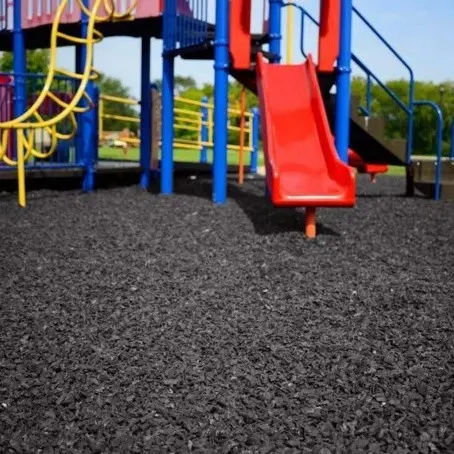
Where does rubber mulch come from?
Made from recycled rubber, often processed from tires, this material is distinguished by its ability to stand the test of time without degrading. Unlike traditional organic mulches, it does not decompose, compacts very little and maintains a stable appearance through the seasons. Its appearance, sometimes textured to resemble wood, is now being integrated into increasingly refined environments, although its aesthetic remains different from the natural materials favored in high-end landscaping.
Why use rubber mulch?
In fact, it's in very specific applications that rubber mulch reveals its full potential. It is mainly found in children's play areas, where safety is an absolute priority. Its flexible composition absorbs impacts, reducing the risk of injury from falls. In a residential context, it is a relevant solution around play modules, where surfaces must be resistant, stable and safe.
The benefits of rubber mulch
The durability of rubber mulch is undoubtedly a considerable advantage. Whereas wood mulch requires regular maintenance and frequent renewal, rubber remains in place for several years, with no significant loss of volume or color. This stability makes it a particularly attractive option for high-traffic areas or spaces where maintenance needs to be kept to a minimum.
That said, its use deserves thoughtful consideration in an overall design approach. In high-end projects, where the aim is to create a natural, rich and timeless ambience, organic materials such as wood or plant ground cover are often favored by designers. Rubber mulch, on the other hand, finds its place strategically, as a complement in specific areas where its functionality outweighs aesthetic considerations.
Well-integrated, it becomes a discreet ally in the service of experience and comfort, without compromising the harmony of the project.
FAQ
Is rubber mulch safe for children?
Yes, it is designed to absorb impacts and is widely used in both residential and public playgrounds.
How long does it last?
Unlike organic mulch, it can last for several years without needing to be replaced.
Is it an ecological option?
It is made from recycled materials, which contributes to the recycling of tires. However, it does not decompose like natural mulch.
Can it replace traditional mulch everywhere?
Not necessarily. It is particularly suited to functional areas (playgrounds, walkways), but less used in high-end landscaping where natural aesthetics are sought after.
Recent posts





Tuesday, July 8th, 2025






Share this post

© 2026 - Aménagement Régimbald